Trinity 18
…Click on the above title for the bulletin.

Gospel Preaching – Bible Teaching – Tucson, AZ
Trinity 18
…Click on the above title for the bulletin.
This week provides another opportunity this year to hear Psalm 2 as part of the Lord’s Services to us. In this place, its divinely inspired words that declare the Christ may be heard each Christmas Day, at the Transfiguration of our Lord, on Easter Tuesday, today, and during the minor Feast of St. Joseph. Psalm 2 continues to be proclaimed among us primarily because it is a thoroughly Christological text. That means that Psalm 2 declares Christ Jesus as King of kings!…For more, click on the title above.
Trinity 17
…Click on the above title for the bulletin.
Trinity 16
…Click on the above title for the bulletin.
One of these early Christian sermons reflecting on our readings remarks on today’s theme saying, “The Lord has visited His people, not only once by the Incarnation of His Word, but by sending It at all times into our hearts.” That is exactly what is happening for you today. Today, we have two of the seven resurrections prior to Christ’s in our readings to bring to our remembrance what God promises to do for you….For more, click on the title above.
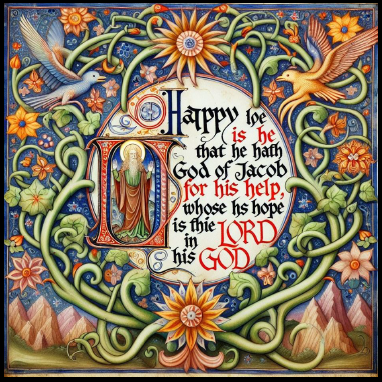
Our selected verse upon which we will meditate this day reads as follows: “Blessed is he whose help is the God of Jacob, whose hope is in the Lord his God.”
Another translation of that passage changes the first word from “blessed” to “happy.” You can see that on the bulletin cover.
Happy is he whose help and hope is the God of Jacob. I like that translation because our Gospel text for today kind of explores the opposite of choosing the God of Jacob—the one in whom we put our trust—to be our Master….For more, click on the title above.
Trinity 15
…Click on the above title for the bulletin.
The Word of the Lord in the Psalm section appointed for today begins with a question. That begins to be answered by in the same verse. The answer then continues through the following seven verses.
Today’s eight psalm lines reveal how beautiful, wonderful, beneficial, and important it is to meditate upon God’s Word. They proclaim that is done as faithful people audibly declare His Word. As many of us have heard here over the decades, God’s Word is not meant to be read silently. It is to be spoken, chanted, or sung that it might enter into the ears of speakers and hearers alike….For more, click on the title above.